
Environmental headlines: Is the world falling apart?
CTV.ca News
The environment was top of mind for much of this year, with mostly gloom and doom science stories about everything from shrinking ice at the poles, to the ever-expanding hole in the ozone layer making headlines around the world and causing us to wonder whether our world is falling apart.
Of course, the global economic storm has pretty much swamped all other issues off the table in recent months, but as the year comes to a close we thought it was time to recap some of the eco-stories that sparked fear in our hearts, caused us to recycle more, gave us hope or simply raised our awareness about the fragility of our planet.
Here are our top five from 2008:
Ice is melting and not coming back:
This one is pretty much exactly how it sounds. New research from the National Snow and Ice Data Center in Colorado this year showed that Arctic sea ice is at its lowest level in 30 years.
"It's very different from in the past when you had a low year and you tended to rebound. We haven't been doing that anymore," Julienne Stroeve, a research scientist at the centre, told CTV.ca.
Typically, in a given year, Arctic sea ice melts each summer and reforms in winter. However, Stroeve said more and more of that ice is melting into the sea as temperatures rise, and it's failing to reform in winter.
"The key thing seems to be the ice is just becoming really thin and it's that much more vulnerable to natural variability."
Stroeve's grim prediction: It may be too late to turn the tide. In the meantime, rising Arctic air and water temperatures are affecting polar bears, seals and all animals that need the ice to survive, as well as the indigenous people that hunt them.
"It's scary. It's such a huge change that's happening very quickly and it makes me very sad," she said.
A few months later, in December, NASA released numbers that said more than 2 trillion tons of land ice in Greenland, Antarctica and Alaska has melted since 2003 -- enough to fill up 11 Chesapeake Bays.
Greenhouse gases hit record highs:
Research from the United Nations weather agency this year found that the three main greenhouse gases in the Earth's atmosphere had reached record highs, despite widespread efforts and seemingly endless hot air from world leaders about the importance of reducing carbon emissions.
Carbon dioxide, methane and nitrous oxide were all at their highest levels, the World Meteorological Organization said. It was the first time in a decade that methane concentrations in the atmosphere actually increased.
If the levels continue to rise, the UN warned, droughts and floods will be the catastrophic result.
Biofuels shocker -- they're actually bad for the environment?
While biofuels had been touted as both a more environmentally-friendly fuel option and a key to reducing North American dependence on foreign oil, a study this year turned that theory on its head.
The study in the journal Science found that the production of biofuels in the U.S. will also double the output of greenhouse gases, rather than reducing it.
Biofuels were also blamed this year for causing the price of corn and other food staples to rise, helping drive a food shortage since fewer farmers were producing crops intended to end up on a plate.
The study found that early projections on the value of biofuels failed to account for the fact farmers clearing grasslands and forests to meet the demand for biofuels, would actually have a detrimental effect on the environment.
The Renewable Fuels Association in the U.S. said "biofuels alone are not the silver bullet" for the world's energy or environmental challenges. That came after the E.U., Canada and others all set minimum required biofuel content for all gasoline.
2008 ozone hole among largest on record
Remember the pesky hole in the ozone over Antarctica? Once the focal point of the environmental movement, the hole has slipped from the headlines in recent years, though it hasn't gone anywhere.
And this year, according to NASA, the hole's frayed edges stretched to 27.2 million square kilometres -- a little larger than the entire land mass of North America, and more than 2 million square kilometres larger than in 2007.
Ozone is harmful to humans at ground level, but acts as a filter in the atmosphere against ultraviolet light.
Although the hole is at its 5th largest this year, the prevalence of substances that deplete the atmosphere such as chlorofluorocarbons, or CFCs, has fallen by 3.8 per cent since 2000 when the rate peaked.
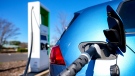
Will the Chevrolet Volt electric car save GM...and the environment?
Speculation about this still-in-development car has ran rampant this year, especially as the North American automaker faces serious financial woes and is increasingly forced to point to the Volt as its saviour.
Record-high fuel prices have put massive pressure on the Detroit automakers to reduce their use of petroleum, and the Volt has largely become the focal point for efforts to meet that demand.
The car is touted as being able to travel 65 kilometres on an overnight charge, without a single drop of gas, and up to 400 kilometres with a boost from its combustion motor.
The sleek vehicle is slated to be launched in November of 2010, but new television commercials for GM's top cars end with a somewhat ominous "and one day...Chevy Volt."